

Managing Users & Environments
How to invite, update, or remove users on your team, manage user roles, set up separate environments via workspaces, and manage your workspace data.
You can manage your organization's users and workspaces in the User Management page of the Recall dashboard.
Roles
Organization-wide roles determine what actions users can perform:
| Role | Description |
|---|---|
| Developer | Able to access the dashboard and create API keys. |
| Admin | All the privileges of the "Developer" role. Can also create new workspaces, invite new users, and manage the permissions of other users. |
User Management
Users can join multiple workspaces in your organization. This allows a single user to have their own development environment while also having access to staging and production environments if desired.
As an admin, you can delegate workspace access for the other users in your workspace.
Workspaces
You should have multiple workspaces to separate different environments. Each workspace operates independently, with its own settings, users, and API keys, allowing you to develop and test changes in isolation.
Note: Workspaces are meant to be used to separate development/testing environments from production, and you should not use multiple workspaces to separate data for your own end users. Data access and permissions for your own end users should be managed at your application level.
Only admins can create new workspaces and manage workspace permissions.
Creating a new workspace
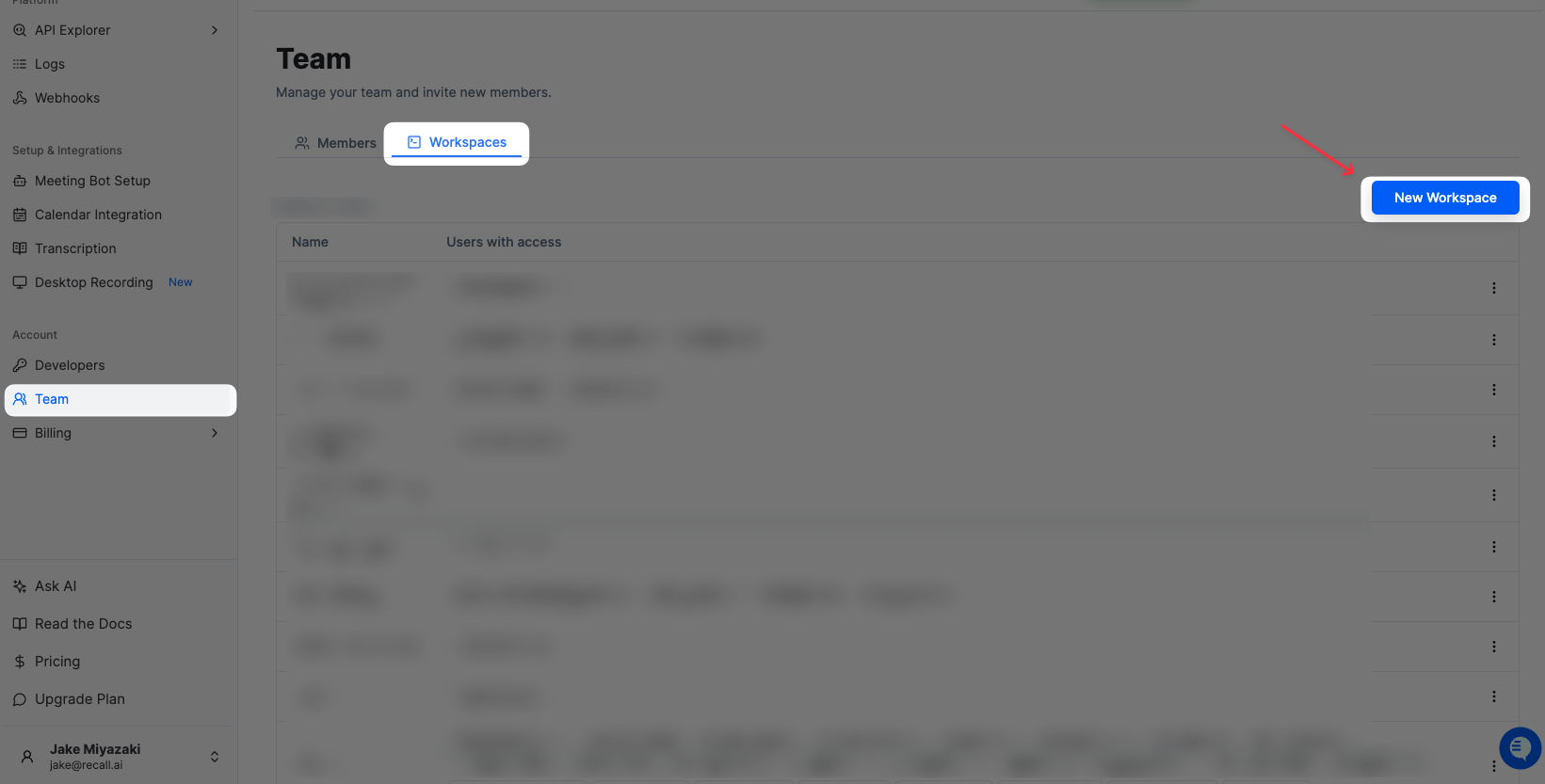
If you're an Admin in your organization, you can create new workspaces from the Team page in the dashboard under the Workspaces tab:
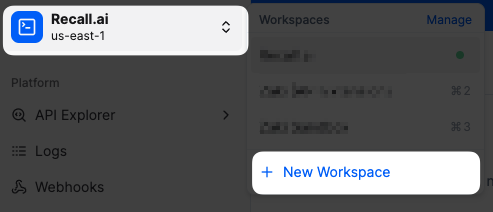
You can also create a new workspace using the workspace switcher in the top left of the dashboard:
Note: You can create a maximum of 50 Workspaces. Currently you cannot delete workspaces yourself, but if you'd like a workspace to be deleted please reach out to support.
Managing workspace access
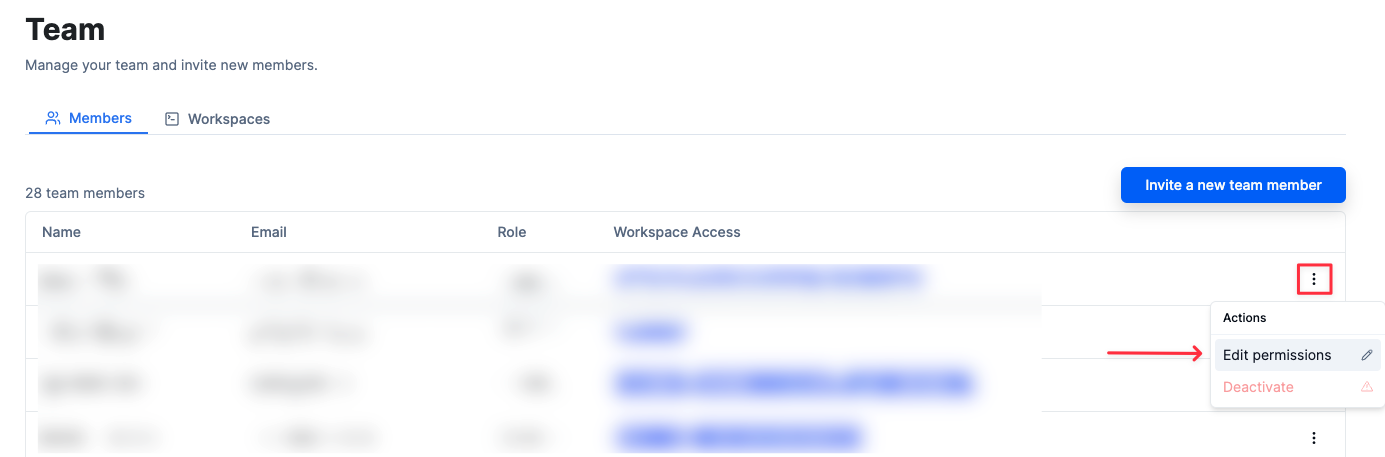
Admins can also update which team members can access workspaces from the Team page under the Members tab:
Creating a new workspace in a different region.
Each region is a separate deployment, so moving your integration requires new workspaces and credentials in the target region.
To create a new workspace/acocunt in a different region: contact [email protected] with your current region, target region, and workspace names. Support will provision your new account and ensure that your billing is configured across all workspaces in each region.
Note that existing data within the existing workspace (e.g., calendars, recording data, scheduled bots) is not migrated to the new region. See Migrating workspaces between regions for the setup and cleanup steps.
Billing
You do not have to pay an additional platform fee or other fee in order to use multiple environments. You do not have to pay for a new workspace in a different region either.
Any usage will be consolidated under the same billing account as your production credentials.
FAQs
How do I manage dedicated environments?
You can create a separate workspace per environment in the Recall dashboard. All data is scoped at the workspace level (i.e. bot data, webhook urls, calendars, platform credentials, transcription credentials, etc.) so a separate workspace will ensure the data/configs will be isolated to your environment
How do I delete a workspace?
You can't delete a workspace at this time. Instead, you can remove all users from the workspace and rename the workspace to indicate it is unused/deprecated.
How many workspaces can I create?
You can have a maximum of 50 workspaces.
How do I prevent developers in my Recall org from accessing production recordings and transcripts?
Since Recall is a service-layer integration, access is workspace-scoped. There is no per-meeting, per-bot, or per-recording permission layer. Any user with access to a workspace can access that workspace's bots, recordings, and transcripts via the API or Explorer dashboard.
While some orgs may prefer giving developers direct access to production data to enable their team to debug and triage issues efficiently, you may prefer that production data is not accessible by any employee accounts.
The recommended way to limit production data access is to use separate workspaces as environments. A typical setup looks like:
- A single production workspace: Access limited to a dedicated service account (e.g. [email protected]). No individual developer accounts.
- Development workspace(s): A dedicated development workspace that all developers have access to. Alternatively, you can provision a new workspace for each developer if preferred.
With the above setup, developers are granted API access to build and test without having access to production data.
Do you support single-tenant environments or per-customer data isolation?
No. Recall.ai is a multi-tenant platform and serves as the ingestion layer for all of your application's conversation data. We don’t have a first-class concept of your individual customers, and don’t provide per-tenant environments or access controls on your behalf.
If you need strict data isolation between customers, that must be implemented in your own database and application layer (just like the rest of your product data).
We do support Custom Metadata, which lets you tag resources with your own user IDs, org/tenant IDs, or other identifiers for filtering and querying.
However, this is not a security boundary and does not change where or how the data is stored in Recall.ai, it’s purely for labeling and lookup.
To ensure that each of your users can only access their own meeting data, you should:
- Associate Recall.ai resources with your own user/org IDs (via custom metadata or within your own database).
- Enforce access control in your own API and UI so that users can only request and view data that matches their IDs.
How do I delete my account?
Please reach out to [email protected] for assistance with account deletion.
Updated 2 days ago